
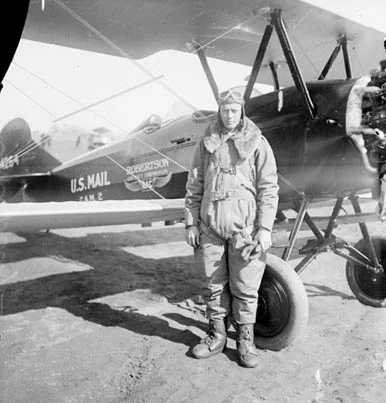
On the evening of November 3, 1926, aviator Charles Lindbergh, flying blind and out of fuel at 13,000 feet, jumped out of his airmail plane over the skies of Central Illinois. Parachuting onto a farm just outside of Covell, a hamlet some half-dozen miles southwest of Bloomington, “Lucky Lindy” made what might be the most dramatic entrance of any visitor in McLean County history.
Less than six months later, Lindbergh became one of the more celebrated figures of the 20th century when he completed a solo, non-stop flight across the Atlantic Ocean. His May 20-21, 1927 journey in the single-engine monoplane Spirit of St. Louis remains one of the seminal events of our modern age. The unknown pilot who earlier caused a minor sensation in a small patch of downstate Illinois was now one of the most famous persons on the planet.
Back in the fall of 1926, a 24-year-old Lindbergh was delivering U.S. mail for the Robertson Aircraft Corporation, operating out of what was then known as Lambert-St. Louis Flying Field. Robertson had the federal government contract to deliver air mail between St. Louis and Chicago (or rather, the western suburb of Maywood), with stops in Springfield and Peoria.
Much of what we know of that eventful night of November 3, 1926, comes from a detailed interview Lindbergh gave to Curtis S. Bill, a reporter for The Daily Bulletin, a Bloomington newspaper absorbed several years later by The Pantagraph.
Lindbergh left Lambert Field at 4:20 p.m., and 55 minutes later his fabric-wing, plywood fuselage De Havilland DH-4 biplane landed without incident in Springfield. After a brief stop for mail he was back in the air heading toward Peoria, but he soon encountered poor weather and poor visibility in the form of snow and low clouds.
In an era before surface-to-air radio communication and sophisticated weather modeling, let alone Doppler radar or the Global Positioning System, pilots had to maintain visual contact with the ground. “You see,” Lindbergh told Curtis Bill, “the clouds same so close to the earth that I could not get low enough to find a place to land.” After circling the Peoria area for 30 minutes and unable to establish his exact location, he decided to head northeast to Chicago in the hope of reaching clearer skies.
A little after 8:10 p.m., with the main and reserve fuel tanks dry and with no viable options other than bailing out, he dove over the left side of the cockpit into the inky darkness below, encountering first blowing snow, then heavy sleet and, as he neared the ground, rain. This was his fourth emergency parachute drop, but the first made in total darkness, and at 13,000 feet it was considered a nighttime record.
Lindbergh landed atop a barbed wire fence on Robert Runge’s farm about one mile south of Covell, his heavy flight suit sparing him serious injury. He packed up his chute and followed a road and distant lights to tiny Covell. He walked into Joe Williams’ general store wearing a bearskin-lined khaki coat, with thickly padded, mud-spackled and torn pants. “Anyone hear a plane crash?” he was supposed to have asked the startled group of men whiling away the evening with cards and conversation around a pot-bellied stove.
B.K. “Pete” Thompson offered the services of his father’s Model T, and after a fruitless search for the wreckage, he drove his unusual guest to Bloomington so he could catch a Chicago & Alton Railroad train to Chicago. Lindbergh returned by plane the following day to learn the crash site was but several hundred feet from the Thompson farmhouse, where he had left his parachute the night before.
The doomed aircraft had slid some 75 feet before coming to rest in a pasture next to a hedgerow. “A giant landing wheel was hurtled over two fences and came to rest more than 50 yards from the plane, in a small hog house,” reported The Pantagraph. “Had it gone another 50 yards it would have disturbed the peaceful cows that were chewing their cuds around a straw stack.”
For his part, Lindbergh seemed most concerned about ensuring the mail under his charge made it safely to Chicago. One bag was split open and its contents scattered and soaked in oil, but the remaining letters and packages were no worse for wear. Lindbergh gathered up the mail and was back in the air heading toward Chicago and (little did anyone know at the time) worldwide fame and fortune.