
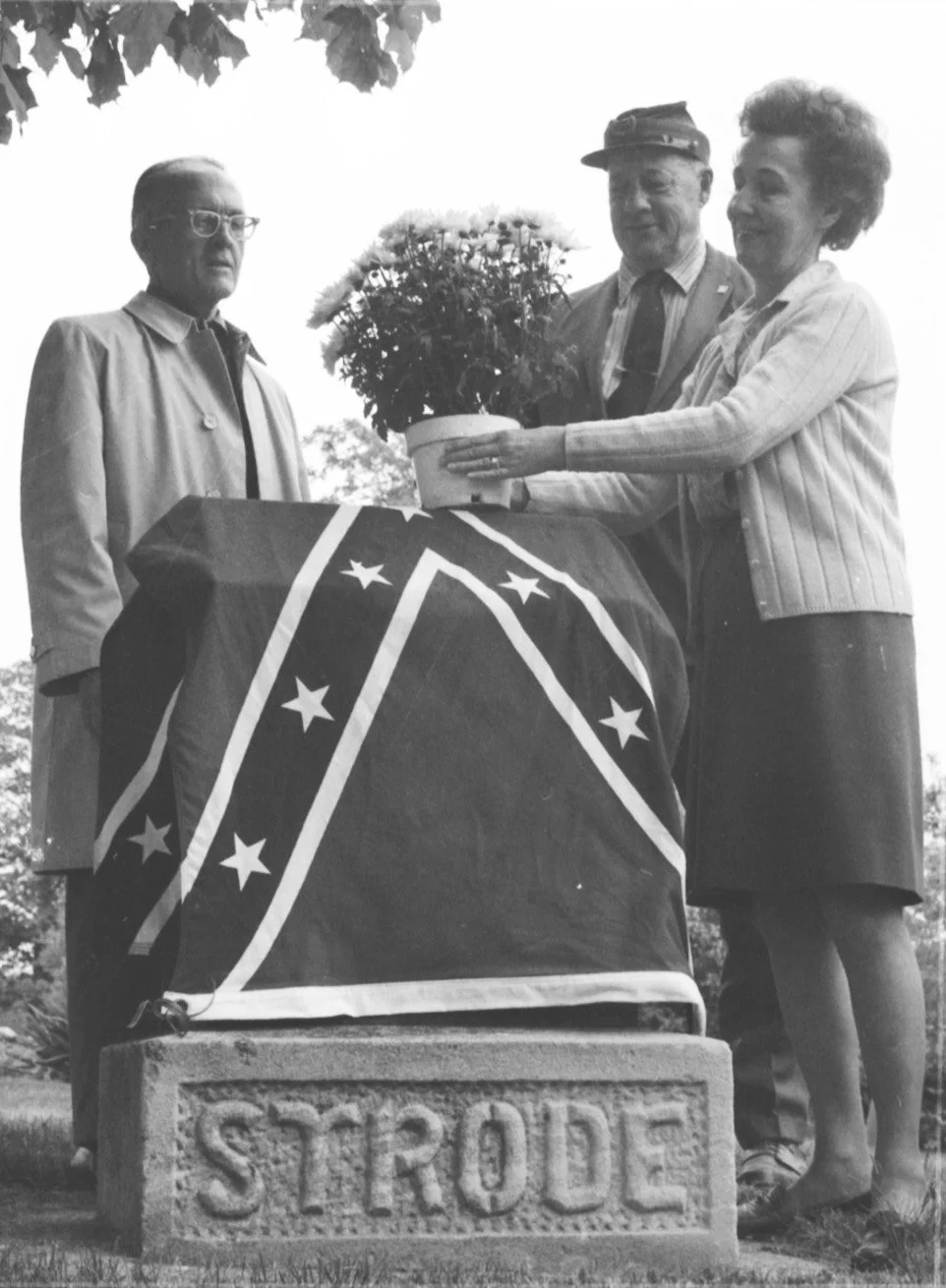
In May 1971, a ceremony was held at Scrogin Hill Cemetery southwest of Bloomington for Civil War veteran William B. Strode. Although the war had ended 106 years earlier, such graveside memorials were not uncommon. What made this gathering unusual, though, was the fact that Strode had fought for the Confederate States of America.
Befitting a dashing Confederate cavalryman of the Lost Cause, Strode participated in Brig. Gen. John Hunt Morgan’s lively but ill-fated incursion into southern Indiana and Ohio in the summer of 1863. “Morgan’s Raid,” as it became known, terrorized many northerners and served as a morale booster for desperate southerners reeling from the twin defeats at Gettysburg, Penn. and Vicksburg, Miss.
Many of Morgan’s nearly 2,500 mounted “Johnny Rebs,” including Strode, were captured in late July 1863 in Ohio and sent to Camp Douglas, a prisoner of war camp in Chicago. After the war, Strode settled in Shirley, and it was there, lo and behold, that he came upon and recognized local resident John Foster. During Morgan’s Raid a few years earlier, Foster’s family was living in Ohio and Strode had apparently taken an uninvited and unwelcomed nap at their home!
Strode died in 1892, and he was first laid to rest at the Shirley Cemetery but later re-interred at Scrogin Hill.
At the time of the 1971 ceremony, many area residents believed Strode was the only Confederate veteran buried in McLean County. That proved untrue. Subsequent research by area genealogists, Civil War buffs and the McLean County Museum of History has turned up at least 25 Confederates buried in the county. There are undoubtedly more.
Most of these men settled in McLean County after the war, some soon thereafter and others later in their life. Sometimes marriage pulled them north, but more often than not it was the promise of economic opportunity in the emerging Corn Belt and its booming railroad towns and cities.
Despite having fought to secede from the union and create a new nation forged not in liberty but in slavery, these Confederate veterans were welcomed by their new Yankee neighbors. And despite several transplanted “sons of the South” remaining adamantly unapologetic and unaccepting of the war’s moral, civil and constitutional reckoning, they were looked upon as comrade-in-arms by most Union veterans, and as veterans worthy of esteem by the general public.
The warm reception was somewhat surprising, given McLean County’s war record. In the first months after the fall of Fort Sumter, more than 3,200 men from the county joined 15 different Union regiments. By war’s end almost 7,000 county men had enlisted in the Union Army, and around 700 of them never made it back home. Their wartime letters to family and friends often featured vitriolic disparagement of lowly southerners and the “damned secesh” (the latter being the preferred slur for secessionist).
The postwar embrace of southern soldiery in the North was galling to some, especially black Union veterans who fought for their freedom and the freedom of all African-Americans in bondage. “Colored” veterans faced discrimination in the North upon returning home, and all too often were denied educational and occupational opportunities afforded Confederate veterans simply by virtue of the color of their skin.
By 1915, the 50th anniversary the war’s end, the nation’s racial climate had turned far uglier. For many white Americans, the Civil War had become a tragic national story of shared sacrifice and suffering on the battlefield. Meanwhile, the many looming questions involving African-American civil and political rights were either shunted aside or purposefully forgotten.
Frank M. Crickenberger is one of five Confederate veterans buried in Wiley Cemetery, located outside of Colfax in Martin Township. “Mr. Crickenberger was highly respected and well like by a large acquaintance in Colfax and surrounding territory,” noted the Colfax Press newspaper upon his death in 1938 at the age of 91. “The highlight of his life was his service as a soldier in the Confederate army, being a resident of Virginia at the time of the rebellion his sympathies were naturally with the South.”
Crickenberger and his wife Eva Cline Gish settled in Colfax in 1880, and he went on to earn a living as a contractor and mason. “He was accepted as a companion and comrade by the federal soldiers [Union veterans] in Colfax and vicinity after coming here, and spent many hours discussing the great conflict with them,” continued the Colfax Press, “but he never quite forgave the North for their part in the war.”
Then there is the hard-to-believe (though apparently all-true) story of David Dawson Haggard, Jr., who was born in Kentucky but came to Bloomington in 1836 as a young child with his family. When hostilities broke out Haggard cast his lot with the South. After fighting for the Confederacy he returned to Bloomington and raised a family with his second wife Mary Elizabeth Ballard. Evidently all was forgiven when it came to this hometown Confederate! David and Elizabeth are buried at Evergreen Memorial Cemetery in Bloomington, as is Haggard’s first wife, Nancy Minter, who died in 1854, and his father, David Haggard, Sr., a Revolutionary War veteran.
There has been considerable controversy this year over the display and meaning of the Confederate battle flag, as well as the legacy of many public monuments to the Confederate cause. That said, few Americans question the right and propriety of fellow Americans to decorate and honor the graves of southern soldiers, especially those from the rank-and-file.
Take, for instance, the local example of Luther Penick Chaudoin (1842-1896).
Born into a Kentucky slaveholding family, he enlisted in the 6th Kentucky Infantry Regiment in the fall of 1861. Chaudoin’s regiment was part of the famed First Kentucky “Orphan” Brigade that was initially led by John C. Breckenridge, the former U.S. vice president and 1860 presidential candidate. From the Battle of Shiloh in April 1862 to Sherman’s March to the Sea and the bitter end during the spring of 1865, the First Kentucky Brigade was in the thick of some of the worst fighting of the war. The brigade lost two commanders on the battlefield, including Benjamin Hardin Helm (President Lincoln’s brother-in-law, no less), who was mortally wounded at Chickamauga.
Chaudoin himself was wounded and permanently disabled on May 28, 1864, after being shot in the face in the meat grinder of the Atlanta campaign. After the war he married Mary Ellen Bray and remained in Kentucky. He then moved to Heyworth sometime around 1893 to join one of his sons, James.
In June 2012, Gary Simpkins and the Simpkins Military History Museum in Heyworth organized a ceremony for Chaudoin at his Heyworth Cemetery grave. Chaudoin’s military background was pieced together by Heyworth historian Lona Soice.
The commemoration included Union and Confederate reenactors and buglers, and the unveiling of a Confederate cross of honor at the gravesite. Those in attendance included great-great-grandson Lloyd Chaudoin and great-great-great-granddaughter Bree Chaudoin, both of Clinton.