
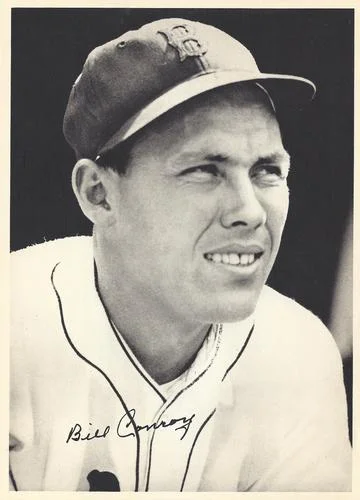
World War II played havoc with Major League Baseball lineups. From untested rookies to future hall-of-famers, it seemed as if one big leaguer after another during the war got the call from Uncle Sam to serve in the Army, Navy or Marine Corps.
The depletion of MLB rosters from 1942 through 1945 opened the door for more than few journeymen minor leaguers, giving some a second shot at the game’s biggest stage. One of these lucky ballplayers was Bob Conroy of Bloomington.
A right-handed catcher who played in parts or all of ten minor league and six big league seasons, Conroy’s best known for his three years, 1942-1944, with the Boston Red Sox. He appeared in 141 games during this wartime stretch, and it’s likely he would’ve played in more if not for injuries.
William Gordon “Bill” Conroy was born in 1915 in Bloomington. The family lived on West Walnut Street, with the father, William J. Conroy, a conductor for the Chicago & Alton Railroad. In his formative years, the younger Conroy cut his teeth on “indoor baseball,” an early form of softball. It wasn’t until his sophomore year at Trinity High School (now Central Catholic) that he took up organized baseball.
Conroy then attended Illinois Wesleyan University for two years, lettering at least one year in baseball, basketball and football. The “handsome dark-haired Bloomington boy” was hailed in his time as one of the most talented all-around athletes to ever don to the “Green and White.”
Sometime in 1933, during a game against Bradley Polytechnic Institute of Peoria (now Bradley University), a scout working for the Philadelphia Athletics spotted IWU’s budding 18-year-old superstar. Soon afterward, Conroy and his father met Connie Mack, the Athletics’ legendary manager and owner. The two parties came to some sort of oral agreement, and the young Conroy spent the next two seasons as the big league club’s batting practice catcher. He kept his amateur status, according to one version of events, because the organization slyly maintained that he was paid for selling tickets, not playing ball!
Conroy also caught American League batting practice at the inaugural Major League All-Star Game, held July 6, 1933, at Comiskey Park in Chicago. Conroy later recalled that Babe Ruth of the New York Yankees, the last A.L. all-star to take batting practice, fouled off a pitch, which “split open my right hand and I couldn’t catch again for five weeks.”
There’s some evidence that Conroy excelled on the field at the expense of his studies. In late January 1934, “Old Man Ineligibility” (in The Pantagraph’s phrasing) caught up with a surprising number of big men on the IWU campus. For his part, Conroy failed a midyear examination and was ruled ineligible for the rest of the season.
It didn’t much matter, though, for by the spring 1934, Conroy was back in Philadelphia. “He was with the team all year, catching some exhibition games, but finding his chief value in warming up pitchers,” it was said. Interestingly, Conroy was the Philadelphia Athletics catcher in the organization’s first night game, an Aug. 31, 1934 exhibition against the Newark, N.J. Bears of the International League.
The Bloomington-born and Bloomington-raised backstop (as catchers are sometimes called) appeared in his first official Major League Baseball contest during the 1935 season. On Sept. 21, he caught the first game of a doubleheader against the Senators in Washington, D.C. It would be his only big league appearance that year, as he spent much of his time in Richmond, Va., of the Class B Piedmont League.
During the next six years, 1936-1941, Conroy toiled mostly in the minor leagues and mostly in obscurity.
The looming war with Imperial Japan and Nazi Germany, though, brought sweeping changes to the National Pastime. Near the end of the 1941 baseball season, the Boston Red Sox drafted Conroy, then playing for the Oakland (Cal.) Oaks of the Pacific Coast League. The “BoSox” front office apparently saw value in this 26-year-old minor league catcher. As a married man with a two-year-old daughter, it was unlikely Conroy would face military service during the war’s early years.
When the U.S. declared war on Japan on Dec. 8, 1941, Conroy had last appeared in the big leagues four years earlier, in 1937. Even so, the Boston Red Sox staff believed he had the potential to be a serviceable journeyman catcher.
As such, Conroy appeared in 83 games in 1942, though he struggled at the plate, batting a meager .200 in 250 plate appearances. His season was then cut short after he broke a finger in his throwing hand.
For the 1942-1943 offseason, he returned to Bloomington to put in eight hours a day as a blacksmith at the sprawling Alton Railroad Shops on the city’s west side. Accompanying Conroy were his wife Gerarda (the two were married in 1935) and their three year old daughter.
At the time, his teammates included leftfielder Ted Williams, arguably the greatest hitter in the game’s long and rich history. But even “Teddy Ballgame” would miss the next three seasons, 1943-1945, to military service, serving as a naval aviator with the Marine Corps.
Meanwhile, spring training for the wartime Red Sox got underway on March 27, 1943, at Tufts College, in Medford, Mass. “If he shows he can mash that old potato, he has a chance to be the No. 1 catcher in Boston this year just as he was all last summer until he smashed that finger,” declared The Pantagraph before the start of the season.
Despite such hometown optimism, Conroy never became the Red Sox everyday starting catcher, though he made it into 58 Major League games over the next two seasons, 1943-1944. Whatever chance he had to demonstrate his worth in “The Bigs” ended with his induction into the Navy in January 1945. He was the third Red Sox catcher lost to military service.
With the war over by the start of the 1946 season, Conroy returned to minor league ball. He never made it back to the major’s.
Conroy’s playing career came to end after the 1948 season with Columbus, Ohio, of the American Association. He and his family then settled down for good in Alameda, Calif.
Bill Conroy passed away on Nov. 13, 1997, in California, from complications due to diabetes. He was 82 years old.
Say what you will about Conroy’s admittedly lackluster big league career (if only when it comes to cold and uncaring statistics), but really, how many players, upon retirement and in their latter years, could say they played alongside a near-mythic figure like Ted Williams?